Description
NEO T-CDA – LED Desk Lamp 80 W, Direct/Indirect, UGR < 13 – silver housing
11,200 lm · 4000 K · Ra > 80 · touch dimming · motion and daylight sensor · silver housing
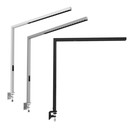
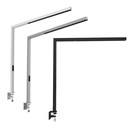
An office luminaire that costs not a centimetre of floor space: this version is mounted to the desktop with a clamp fixture and lights the workplace from two sides – indirectly via the ceiling for calm ambient brightness, directly downwards for sufficient light on the desk. Clamp it, plug it in, done; no drilling or ceiling work required. If the workplace moves, the luminaire simply moves along. The narrow, straight design looks tidy and suits contemporary workspaces.
Key benefits at a glance
Glare-free to standard UGR < 13 – well below the limit for screen work. | Direct and indirect 60 W via the ceiling, 20 W straight onto the desk. |
No drilling Clamped to the desk – no work on the ceiling. | Sensors included Motion and daylight sensors reduce consumption. |
High efficiency 140 lm/W – 11,200 lm from 80 W. | Long service life L80(B10) at 50,000 h, no lamp changes. |
Features in detail
- Direct/indirect luminaire with 60 W upward and 20 W downward
- Glare limitation UGR < 13 through micro-reflector optics
- Colour temperature 4000 K
- Colour rendering Ra > 80
- Touch dimming, direct and indirect light adjustable asynchronously
- Motion sensor and daylight sensor as standard
- BOKE driver, SMD 2835 LEDs
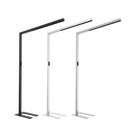
- Housing available in silver, black or white
Direct and indirect light: why the split?
The output is split into two directions: 60 watts go upwards, 20 watts downwards. The principle is simple: light arriving via the ceiling looks soft and low in shadow because it comes from a large area rather than a point. So that enough still reaches the desk, the direct share supplements the lighting from above. In practice this means bright working light without harsh contrasts and without reflections in the monitor.
UGR < 13 – what it means for screen work
UGR stands for Unified Glare Rating and is the measure of glare. Ordinary office luminaires must stay below 19; this luminaire reaches a value below 13 and therefore sits in the range recommended for demanding visual tasks. This is made possible by precise micro-reflector optics with a defined cut-off angle: light is focused downwards instead of scattering widely into the room.
Touch control: dim direct and indirect light asynchronously
Control is via touch-sensitive buttons. Asynchronous means: top and bottom are two separate lighting systems with their own controls. Each direction has its own button for switching and stepless dimming – the brightness of one direction does not affect the other. That is practical because the light needed at the desk and in the room is rarely the same: mornings may call for more room brightness, afternoons for more light on the working surface.
Motion sensor and daylight sensor
The luminaire works with motion and daylight sensors. The motion sensor monitors the area in front of the luminaire; if it stays empty for 20 minutes, brightness drops to 30 percent, and after a further 10 minutes the luminaire switches off. As soon as someone approaches again it switches on automatically. The daylight sensor memorises the brightness once set as a target value and keeps it constant by compensating for incoming daylight. On bright days the luminaire therefore runs at lower power.
Service life and colour consistency
L80(B10) at 50,000 hours describes how reliably brightness is retained over the years: after this operating period at least 90 percent of the luminaires still deliver over 80 percent of their initial luminous flux. Added to this is tight colour consistency of SDCM 3 – neighbouring luminaires in an office therefore show no visible colour differences.
Clamped instead of placed
The luminaire is fixed to the desk edge via its clamp fixture and is ready for use within minutes – power cable into the socket, done. Floor and desk surface stay clear, and ceiling cabling is not needed at all. Especially in small offices and at double workstations, the space-saving mounting pays off.
Housing colour: silver
The housing of this variant is silver. The light metallic tone is unobtrusive and suits almost any environment – from open-plan offices to the study at home. If you are looking for a discreet, timeless appearance, silver is the right choice; alternatively the luminaire is also available in black and white.
Technical data
| Model | NEO T-CDA |
| Type | desk luminaire with clamp mount, direct and indirect light |
| Power | 80 W (60 W upward / 20 W downward) |
| Luminous flux | 11,200 lm |
| Efficacy | 140 lm/W |
| Colour temperature | 4000 K |
| Colour rendering | Ra > 80 |
| Glare rating | UGR < 13 |
| Colour consistency | SDCM 3 |
| Beam angle | 140° upward / 80° downward |
| LED | SMD 2835 |
| Driver | BOKE |
| Voltage | AC 200–240 V |
| Power factor | ≥ 0.9 |
| Dimming | touch dimming, asynchronous for direct and indirect light |
| Sensors | motion sensor and daylight sensor |
| Service life | L80(B10) 50,000 h |
| Housing colour | silver |
| Mounting | clamp fixture for desktops from 0 to 75 mm thick |
| Dimensions | lamp head 1,205 × 50 × 40 mm · pole 1,320 mm · clamp 115 × 120 mm |
| Energy efficiency class | D (EU scale A–G, EU 2019/2015) |
Applications
Typical locations are office workplaces of all kinds: private office, open space, coworking, conference room and home office. The luminaire is particularly useful in rooms with concrete ceilings or in rented premises where ceiling luminaires may not be installed. It equally suits situations where individual workplaces need better light than the rest of the room – at design, inspection or graphics stations, for example.
Scope of delivery
- 1× LED desk luminaire with lamp head, pole and clamp fixture
- Connection cable with plug
- Installation and operating instructions